Hello! We're away from the shop until June 30th. All in-stock orders placed between now and the 30thwill ship on July 2th. All made to order items will ship a bit later (we'll update you on exact time via email).
If you have any other questions, please send us an email:
don@happybungalow.com
Thanks!

Throw Back Thursday – Bunny
/in Process, PrototypeToday we throw it back to just about the first Happy Bugnalow toy ever prototyped. I think it was just about the first thing I ever made on a scroll saw. This was made when Happy Bungalow was just starting up. We were ordering a few pieces of new professional grade equipment, but still trying to make it by on the thinnest shoe-string budgets. So this little animal was cut on a piece of pine that was hanging around the shop.
I drew from (cartoonish) memory the shape of the animal. I was happy that others recognized the shape was a bunny, but disappointed in how lame the thing looked. So I set about drawing animal profiles from real animals (usually from pictures, but occasionally from real life as in our bison toy). When we fist started there were two primary animal lines: farm and safari.
Since we’ve added to our shop woodlands animals, dinosaurs, and mythical animals (think unicorns). In addition we’re working on adding water animals, Australian animals, and just about every other animal that can be rendered in wood.
Reproducing real life animals into small wooden form took some tweaking. Legs were too thin, bellies to bulgy, and the like. Legs are the biggest problem. Like, have you ever seen how thin a horse’s legs are? Or a chicken’s? In the beginning there was a lot of tweaking and fussing to get the animals just right, but now, I think we’ve made close to one hundred different animals so far, we usually nail it down pretty quick.
So kids, remember – what they say is true. Practice Makes Perfect! Or just a lot better.
Throw Back Thursday – Castle Model
/in Process, PrototypeLast time on Throw Back Thursday . . .
We dug up an early prototype of a castle bookend. Well, here’s the computer model that preceded it. Pretty neat looking, and probably pretty fun too, but none of them ever made it into production (read more about why in the original post).
I’ll ramble on a bit about computer models and prototyping. We do all of our 3-D models in Sketchup. It’s a free program that is super-handy, and relatively easy to learn. I’m not the best self-taught computer person, but I figured out the basics of Sketchup in a day or so. A few projects later and I was competent enough to do interior architectural models (I wasn’t always a toy-maker you know). With computer models you can know exact dimensions, work out potential problems, and generate cut lists (how many and how long of pieces of wood you’ll need).
Though, I like to work on the fly, working from simple sketches and physical protoypes (see an example in a post about toy car design and a bit about toy car construction). So we don’t produce too many digital models anymore. I will say though, if we were working on any sizable pieces, we would turn first to a computer model.
You can see in the built prototype that most everything is the same as the digital model. The little dowel people were simplified and the upper windows were more real, but the physical castle was the same. I probably went through 5 different hinge types for the little draw bridge. That was tricky.
The Kids ended up with the castle prototypes, there’s a half dozen of them. So we would hook all the individual wall pieces together (nothing was glued) and make super giant castles. Never a roof though. Inside the castle would sleep cars, princesses, blocks, and whatever else was around. This was in the days when our oldest was figuring out how to go to sleep in a big kid bed by herself, so a lot of play time was devoted to putting her toys to sleep.
Liz and I don’t miss those battles of getting the two year old to go to sleep at night, but we sure do miss that play-time. In case you’re wondering, we have discovered the secret to getting little kids to sleep at night – give them a sibling to sleep in the same room with.
Throw Back Thursday – Castle Edition
/in Miniatures, Process, PrototypeIn recognition of Throwback Thursday we post this old prototype. It’s one of about a dozen attempts at creating castle themed bookends. I never figured out how to make them to the level of quality we strive for, and for the price we thought they could sell at. The idea was for the bookends to be playable toys, outfitted with simple dowel people (much like the little peg people you see everywhere).
Perhaps we need to go back a little further.
Before Happy Bungalow was Happy Bungalow it was Kiddie Kottages. When Liz and I were first dreaming up this business we were going to create playhouses for children (spurred on by the encouragement of friends, see the playhouse here). We made notes and sketches. We created 3D models of the playhouses. We thought up just the right business name and registered domains (until recently kiddiekottages.com and kiddiecottages.com redirected to happybungalow.com).
And then we thought up some little products to accompany the playhouses. The idea was that we’d make the playhouses and everything you needed to put in them. So the original Happy Bungalow product line started out as accessories to Kiddie Kottages’ big playhouses. But starting a new business and creating these multi-thousand dollar playhouses was too much, so we focused on the smaller pieces at first with the goal to move on to playhouses later.
We’ve pretty much given up on the playhouses for the immediate future, but some of those original products still hang on (our wooden animal toys being the most notable). Much like the never realized castle bookends, the dollhouse bookends below went through extensive prototyping (and before that digital models you can read about here), but end the end it was hard to find a workable price-point for them. It was also difficult to generate the level of quality (again at workable price point). Though the shop has expanded its tooling, we might take another attempt at it.
The simple little furniture did prompt a friend to ask if I could make some furniture for her daughter’s inherited dollhouse. Well, that is a product line that has done quite well (read more dollhouse furniture posts here).
So in the end the castle bookends never made it into production. The corner joints (box joints) were the problem. I was attempting to create a faux quoining (fancy architecture word for those stones that stick out on the corner of buildings). Perhaps one of these days . . .
This Toy Will Make Your Kid a Genius
/in Business, Process, Shop TalkWe have loads of toys here at the Bungalow. After all, we make wooden toys for a living. The Kids here have plenty of the same toys we sell, loads of toy prototypes, and scattered one-offs & specials too impractical to produce for sale.
And we have mass-produced, mass-marketed toys as well. We love and adore and appreciate the support of small boutique shops. They’re wonderful, sell awesome stuff that’s just about impossible to find anywhere else. And the people working the shop are terrific passionate people. But . . .
But they don’t sell Barbies. Or Strawberry Shortcake. Or Lights and Sirens On! Firetrucks. And Legos. We have loads of fun with Legos around here. Sure, the wooden toy maker’s kids have plastic toys. Sure, we’ve heard the arguments against these sort of toys. Overseas labor, bad for the environment, durability, etc. And while there are valid points to be made, the world is a complicated and cruel place. We haven’t seen the absolute rule that serves the best interests of the global community.
Mass-produced doesn’t have to mean cheap, and if you take care of the toys, they can hang around for a good while (of course we’re the biggest fans of quality handmade wooden toys – it’s just hard to hand carve a wooden doll that looks just like the ones on the television).
We are firm in having no pretend dangerous toys. We have no toys guns, knives, or swords (as if kids didn’t pretend every stick was a gun or sword anyway). And we certainly don’t endorse toy tools! Last year a gift toy chainsaw spent all of two minutes in the house. Our woodshop is in our basement, and while it’s safely behind a locked door we educate our kids on the dangers of these tools. It’s a hard and fast rule that tools are not toys. There are three saws in our shop that will cut off a hand just as easily as they cut wood. So we want none of our children in the habit of regarding any saw as a toy.
We’re comfortable with some mass-produced toys, but too many are groan inducing.
Like the countless primary-colored, battery-required, insanity-generating models. Especially tiresome are the “educational toys”. I’m pretty sure we’ve never bought one, but they show up here none-the-less (sort of like the dolls and trucks I swear are self-replicating). But you know those “learning toys” that “teach” shapes and colors. And the A, B, and C. Because all you really need in life are three letters.
I suppose one or two of these fellas wouldn’t be so bad, but after a few dozen of the battery hungry monsters accumulate . . .
The packages tout their benefits. Letter recognition. Color recognition. Hand/eye coordination. They’ll improve thinking skills and boost creativity. A greater understanding of math and geometry. Perhaps they’ll increase your child’s IQ. Good grief! Read enough of it and you’d think that singing light-up helicopter will have your kid solving algebra problems in kindergarten.
Even the non-battery operated toys tout their giftedness. We have a fun little block set that promotes color recognition and hand/eye coordination. Doesn’t picking wildflowers do the same thing?
You want a child to learn something? Teach them. Read to them. Once they learn to read on their own, buy them books. And paper. Pencils. Crayons and markers. Get em a cheap camera. Let em loose in the backyard, in the park, go explore your local urban environ. They’ll learn a ton, and I bet they’ll have fun doing it.
You want a child to have fun? Give them a toy. Make a toy with them. Play with them. Before long little worlds will be born and flourish. Great tales will be written by you and your child. You’ll both have a ton of fun, and I bet you’ll learn something while doing it.
Math is Important for Making Toys
/in Business, Process, Shop Talk, UncategorizedWe’ve been making a lot of stars lately. Hundreds and hundreds of stars; which is awesome because someone is paying us to make stuff! How much cooler of a job can you have? But, as we’re making hundreds at a time, it’s best to be efficient at it.
Don has to make 100 stars. If 7 stars fit onto 1.8 feet of maple board, how many feet of board will he need to make 100 stars? (assuming no knots or other defects in the wood that would have to be cut out)
Except there’s no calculator in the shop – only old fashioned long-hand math.
I also figured up how many square inches of wood each star used – this told me my raw materiel cost for each piece.
So yes, math is important. I don’t use calculus in the shop very often, but geometry and algebra are very important. Kids! Pay attention in math class! Don’t end up being the person that needs a calculator to double check his 7 + 7 math.
As a side-diversion:
Before I made toys, I was an architect (technically I still am, I just haven’t done any for-hire work in a while now). The number one response when telling a stranger I’m architect: “You must be good at math.”
Well, I am good at math, I think it’s fun – like solving a puzzle – but surprisingly to most people great math skills aren’t essential to architecture. Basic geometry and a little algebra is all you really need to be competent. A high-schooler would be able to handle most of the math work.
So what’s the number one skill essential to being an architect? Working an unspeakable number of thankless (and unpaid) hours.
As a toy-maker at Happy Bungalow I work more hours, but they are the opposite of thankless. I have fun every day, almost without pause. I mean come on! We’re making toys here. My job is to make toys!
Stop into our online toy shop to take home some of our work.
Happy Bungalow’s Wooden Toy Promo Video
/in Business, Fun Stuff, UncategorizedOur first promo video – put together for a grant application. Filmed on location in the Bungalow. Featuring our super-fun wooden toys, head-artisan Don, and an artist rending of the entire crew.
Happy Bungalow Makes Wooden Toys, Repairs Plastic Toys
/in Fun Stuff, Kid ApprovedAs you might guess, there is no shortage of toys here at the Bungalow. Plenty of wooden toys, sure, but we have some plastic toys as well. We encourage everyone to buy handmade wooden toys, perhaps in our online toy shop, but there are some thing you just can’t make out of wood. Like a tiny ladybug just a bit bigger than a penny (see below). Perhaps you’ll recognize her as the companion of a well known [and skimpily dressed] fairy. Wears a lot of green, has a fondness for lost things, and tinkering.
Anyway. The ladybug is a mighty favorite of one of the Kids here at the Bungalow. A faithful companion for months (literally never leaving his side). Some of the paint eventually wore off, and then off came an antennae. Liz and I were well practiced in finding the ladybug, so despite odds to the contrary, we found the broken antennae (about the thickness of spaghetti and 1/8″ long).
A superglue fix lasted about an hour. “The ladybug broke again!”
Okay. It’s time to get serious.
We can rebuild her. We have the technology. We can make her stronger.
I take our injured bug to the shop (note penny and vintage Lance’s X-Acto knife for scale). She needs a metal rod implanted to strengthen the break. By some miracle a company makes a drill bit just a bit thicker than a human hair (only sort of exaggerating). I carefully drill into the ladybug, then manage to drill into the broken antennae (and not my finger). Snip a piece of wire, glue it together, glue my fingers together.
Wait, what?
Ugh. Yeah, I super-glued my fingers together. Note than slicing the fingers apart with an X-Acto knife is more challenging than you might think. But soaking your fingers nail-polish remover will [eventually] loosen up the glue (read: 1/2 hour of your life spent considering why you didn’t wear latex gloves).
But most importantly the ladybug was made whole and the Kids were happy and thankful.
Of course three weeks later it broke again. To our workmanship’s credit though, the new break was above the bionic implant. The broken piece was lost to eternity, but the Kids came to terms with the loss.
We’re happy to report that Ladybug is worn around the edges, but still well-loved.
Wood Cars and Trucks Design
/in Cars and Trucks, ProcessWe’re envisioning this Car of the Month Club to be something like a jelly of the month club, except much lower in sugar and much higher in fiber*. As rated by the Kids, the favorite new vehicle is (hands down) the fire truck. The semi-truck is a close second though. We’ll be working on a few interchangeable trailers soon.
While these trucks aren’t yet available for purchase we have some other great wooden cars in our shop.
* Our toys are not really edible
Farmers Markets, Art Fairs, and Craft Shows: 2013 Review
/in Shows2013 was a busy year for the Bungalow as we took the show on the road to 33 farmers markets, art fairs, and craft shows. Covering 2 states and half a dozen cities we met lots of cool folks (maybe even you).
It was a great year – thank you for you kind words, fun conversations, and generous support.
We had a great time in Rabbit Hash on the Banks of the Ohio.
We set up outside Music Hall.
And inside Music Hall.
We saw a genuine Delorean (no flux capacitor though)
We made a few buggy friends
And a good time was had by all (though the hot sun did tire some of the robots)
Now we’re heading back to the drawing board (literally) to come up with some new toys: airplanes, robots, boats, mermaids, dragons, and on and on. We have quite the list assembled.
And despite our Delorean sighting, the future has not provided us flying cars. So we’re taking it upon ourselves to produce said vehicle. Or at least a toy version.
Wood Toy Cars – How They’re Made
/in Cars and Trucks, Kid Approved, Process, Prototype, Shop Talk, UncategorizedHow To Make a Wood Toy Car
In 38 Not So Easy Steps
(w/ Illustrations)
Well, I don’t know just how many steps there are, but I bet I’m close. We make our toy cars and trucks like any other toy we make: Quizzing The Kids about what they’d like to see in a new toy. Then come some sketches which they usually don’t understand, but are enthusiastic to support. Next comes some hand-drafted drawings (see picture below) and the first round of prototypes which The Kids understand well.
( You can see the first prototypes in the picture below in the center towards the top of the drafting board. )
So the Kids play with the prototype cars for a while and then we hold a panel review session. It goes something like this:
Me: “What would you say you like most about this product?”
The Kids: “They’re great! Too cool!”
Me: “What would you say you like least about this product?”
The Kids: “They’re great! Too cool!”
This feedback really helps to inflate my ego and solidify my position as Most Awesome Dad.
I play with The Kids, see what other toys are invited to play with the new group, and keep an eye out for rough play that might reveal weaknesses. Then I take the toys back to the shop for simulated play and abusive testing. Weaknesses are corrected and the design/look of the toy is usually tweaked.
Then it’s on to figuring out how I’m going to build these things. It’s one thing to build a one off toy for the fun of it, it’s another thing to make quality toys for a price people are willing to pay. It’s a long process and quickly drifts into the weeds of specifics . . .
Once all the piece are cut, they’re neatly stacked (see above). All the cars have a base and a top, are the same width, mostly the same length, and are all cut with complementary angles. Every car gets two holes drilled for axles (see below) and one small hole on the bottom where the tow truck can hook onto. I use a custom-made adjustable jig for all the drilling.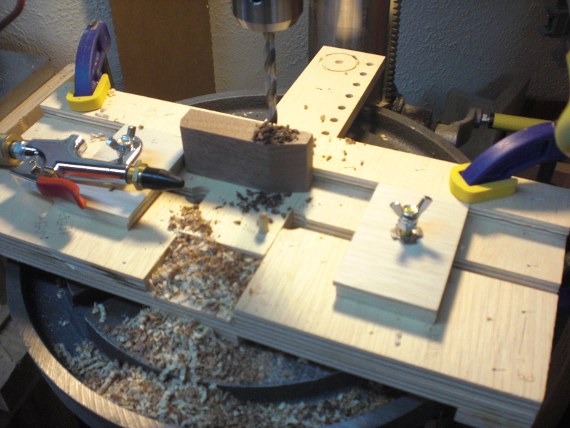 This operations piles up the saw dust – I depend on my compressed air hose to keep the work-surface clear. I drill and drill and drill and drill. You might think drilling holes for an hour or more is boring – but you’re wrong. I get to sit on a stool while I do it. It’s hard to be bored in the shop when you’re feet are happy.
All Happy Bungalow cars are equipped with Strong Ox tires, mfg. Cincinnati, Ohio. They’re cut with a special hole saw. The wheels are made from walnut, unlike most wood toy cars you see which are made from a lighter toned wood (maple or beech) and look suspiciously similar. Our axles are cut from walnut dowels.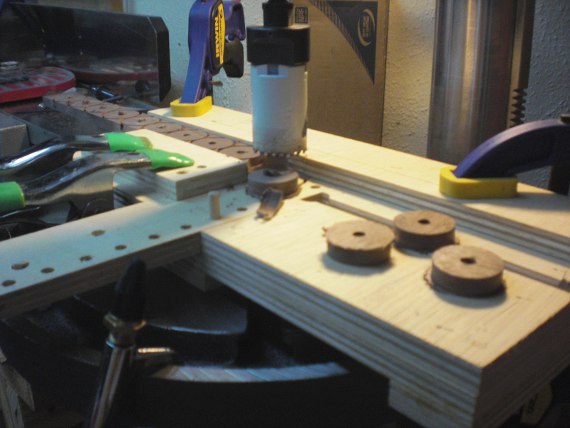 By now there’s a stack of car parts that need gluing, sanding, gluing, sanding, sanding, a smidge more sanding, and finally some natural wax finishing. I use power sanders, but a lot of the sanding work is done by hand. All corners are smoothed over – no sharp edges are left to pester little hands. I cringe to say this, because it sounds like some lame marketing line, but I do pride myself on craftsmanship. Well made, well detailed, and finely finished.